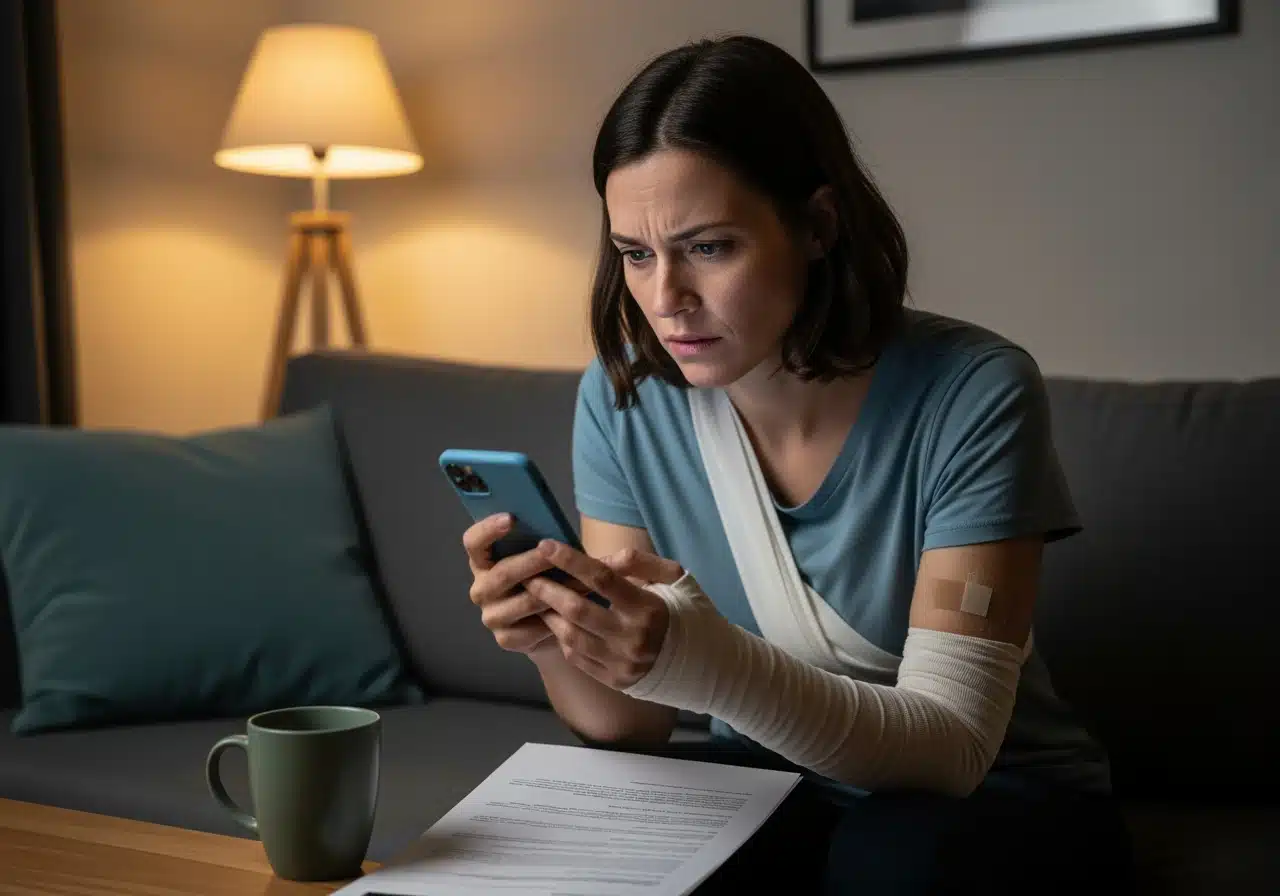
You’re careful about your personal injury claim. You’ve kept your medical appointments, documented your injuries, and followed your lawyer’s advice. But what about that photo your mate tagged you in at the pub last weekend? Or the Facebook post where you mentioned going for a walk?
Insurers and defence lawyers are scrolling through your social media right now. They’re looking for anything that contradicts your claim, and they’re remarkably good at finding it. A single Instagram story showing you lifting shopping bags can undermine months of medical evidence about your back injury.
Understanding the social media evidence NSW requirements has become essential for anyone pursuing compensation. Social media in injury claims NSW cuts both ways; it can strengthen legitimate claims by documenting your recovery journey, but it can also destroy otherwise solid cases when used carelessly. The problem isn’t just what you post, it’s how easily innocent content can be twisted to suggest you’re exaggerating your injuries.
Most people don’t realise their privacy settings offer far less protection than they think. Even “friends only” posts can be accessed through mutual connections, subpoenas, or simply by someone screenshotting and forwarding content.
What Insurers Actually Look For
Insurance investigators aren’t randomly browsing your holiday photos. They’re conducting systematic searches with specific objectives, and they know exactly what undermines different types of claims.
For physical injury claims, they’re hunting for evidence of activities inconsistent with your reported limitations. If you’ve claimed you can’t lift anything heavier than two kilograms, but there’s a video of you helping a friend move furniture, that’s gold for the defence. They’ll screenshot it, timestamp it, and present it as proof that you’re fabricating your disability.
The search extends beyond your own accounts. Investigators check your partner’s profiles, your children’s accounts, and even your employer’s business pages. They’re looking at tagged photos, comments you’ve made on other people’s posts, and location check-ins that might contradict your testimony about being housebound.
We once worked with a client in Penrith who’d suffered a genuine motor vehicle accident injury. Her claim was rock solid, multiple medical reports confirmed significant neck and shoulder damage that prevented her from returning to her job as a hairdresser. Then the insurer’s lawyer produced a Facebook photo from her daughter’s account showing our client at a family barbecue, holding her grandchild. The defence argued this proved she could lift and carry without difficulty. We had to bring in additional medical evidence explaining that brief, carefully managed activities don’t negate chronic pain conditions, but it made the case harder than it should have been.
Why Your “Private” Posts Aren’t Private
You’ve set everything to “friends only.” You’re selective about who you accept. You’re not protected as much as you think.
NSW courts have repeatedly held that social media content, even with privacy settings enabled, can be discoverable in personal injury litigation. The legal principle is straightforward: if the content is relevant to your claim, the court can order you to provide access or produce specific posts.
Defence lawyers can file what’s called a Notice to Produce, requiring you to hand over social media content that relates to your injuries, activities, or lifestyle. Refusing to comply can result in serious consequences, including having your claim struck out entirely. The State Insurance Regulatory Authority (SIRA) oversees these processes to ensure fair access to relevant evidence.
Privacy settings also fail in practical ways. Friends can screenshot and share your content. Tagged photos appear on multiple accounts. Comments you make on public posts are visible regardless of your own settings. Location data embedded in photos can reveal where you were and when, even if you didn’t explicitly check in somewhere.
Social media privacy works like a fence around your backyard; it keeps out casual observers, but anyone with a legitimate reason and proper authority can still get access. In legal proceedings, that authority exists, and it will be used.
The Context Problem You’re Facing
Understanding social media evidence NSW standards reveals how a single photo captures a moment, not the full story of your pain and limitations.
You might have pushed through significant discomfort to attend your daughter’s wedding. The photos show you smiling and dancing for one song. What they don’t show is the three days you spent in bed afterwards, or the increased pain medication you needed. The defence will present those wedding photos as evidence you’re fine. They won’t mention the recovery period.
Similarly, a post saying “great day out” doesn’t mean your injuries have healed. It might mean you managed a short outing with rest breaks, careful planning, and pain management. But stripped of context and presented to a court, it looks like you’re living normally despite claiming disability.
We represented a workers’ compensation client who’d injured his back on a construction site in Western Sydney. He posted on Facebook about taking his kids to the park. The insurer used this as evidence he could perform physical activities without limitation. What the post didn’t mention was that he’d sat on a bench the entire time while his wife played with the children, and he’d needed help getting back into the car. We had to bring in diary evidence and additional witness statements to provide that context.
The burden of explaining context falls on you, and it’s harder than preventing the problem in the first place. Judges and insurers see dozens of claims. They’re naturally sceptical. Once doubt is introduced through social media evidence, you’re fighting an uphill battle to restore credibility.
What You Can Post Safely
You don’t need to delete all your social media accounts or go completely silent online. That can actually look suspicious and may be used against you as evidence of concealment. Instead, you need to be strategic about what you share.
Avoid posting anything that shows physical activity beyond what you’ve claimed in your medical reports. If you’ve stated you can’t stand for more than 15 minutes, don’t post photos from a concert where you’re clearly standing in a crowd. If you’ve claimed you can’t drive due to your injuries, don’t check in at locations that would require driving to reach.
Be cautious with “feeling” updates that contradict your injury status. Posting “feeling great!” on a day you’ve reported severe pain in your medical diary creates obvious inconsistencies. Even seemingly innocent posts like “best day ever” can be interpreted as evidence that your injuries aren’t affecting your quality of life.
Photos of holidays or social events need particular care. Even if you’re managing these activities within your limitations, they can be presented as evidence that you’re living a normal, active life. If you do attend events, consider whether posting about them is worth the risk to your claim.
Generally safer posts include:
- Non-physical activities like reading, watching television, or spending quiet time at home
- Content that doesn’t involve you directly, such as sharing news articles or commenting on current events
- Updates that acknowledge your ongoing challenges, though avoid oversharing medical details publicly
- Photos where you’re clearly seated or stationary, and the activity is consistent with your reported limitations
The safest approach during an active claim is to treat social media as a public courtroom where everything you say can and will be examined by hostile lawyers looking for inconsistencies.
When Social Media Actually Helps Your Case
Social media in injury claims NSW isn’t always against you. When used thoughtfully, it can support your claim by documenting the real impact of your injuries on your daily life.
Timestamped posts showing your recovery journey can corroborate medical evidence. Suppose you’re documenting physiotherapy sessions, medical appointments, or the gradual improvement (or lack thereof) in your condition. In that case, this creates a contemporaneous record that’s harder to dispute than recollections given months later in a statement.
Posts that show the emotional and psychological impact of your injuries can support claims for general damages. If you’ve historically been active on social media sharing social activities, and that drops off dramatically after your injury, it demonstrates how your life has genuinely changed.
We worked with a client who’d suffered a serious injury in a workplace accident. Before the incident, her Facebook showed regular posts about hiking, gym sessions, and active weekends with friends. After the injury, her posts became infrequent and focused on medical appointments, cancelled plans, and expressions of frustration about her limitations. This pattern actually strengthened her claim by showing the genuine impact on her lifestyle and mental health.
Social media can also provide evidence of the defendant’s conduct. In motor vehicle accident cases, we’ve occasionally found posts from the other driver that contradict their version of events or demonstrate reckless behaviour around the time of the collision.
The key is intentionality. If you’re going to post during an active claim, make sure it genuinely reflects your limitations rather than your best moments. Document struggles, not just successes.
What Happens If Damaging Content Already Exists
You’ve just filed your personal injury claim and realised there are posts from the past few months that could be problematic. Your first instinct might be to delete everything. Don’t.
Deleting social media content after filing a claim or receiving a Notice to Produce can be considered destruction of evidence, which is a serious matter in NSW courts. It can result in adverse inferences being drawn against you, meaning the court assumes the deleted content was damaging to your case. In extreme cases, it can lead to your claim being dismissed entirely or even criminal charges for perverting the course of justice.
Courts take evidence preservation seriously. Once litigation is reasonably contemplated, you have an obligation to maintain relevant documents and records, including social media content. Even if you haven’t formally received a discovery request yet, deleting posts after an accident or injury can be viewed as spoliation of evidence.
If problematic content exists, the better approach is to address it proactively with your lawyer. We can assess whether it’s genuinely damaging or whether it can be explained with proper context. Sometimes, content that looks bad at first glance can be neutralised with supporting evidence ora medical explanation.
Your lawyer might advise you to take screenshots of your social media history to preserve it in its current state. This protects you from allegations of deletion while also giving your legal team time to develop strategies for addressing any problematic posts.
We once represented a client who’d posted several photos at family gatherings during her recovery from a workplace injury. She panicked when she learned the insurer was investigating and wanted to delete everything. We advised against it and instead worked with her medical specialists to provide detailed reports explaining that brief social activities within a supportive environment didn’t contradict her functional limitations. The claim succeeded because we addressed the evidence head-on rather than trying to hide it.
The Reality of Insurance Surveillance
Social media monitoring isn’t the only way insurers gather evidence about your activities. Many claimants don’t realise that physical surveillance is common in NSW personal injury claims, particularly for larger claims or where there’s suspicion of exaggeration.
Insurance companies regularly hire private investigators to conduct video surveillance of claimants. They’ll film you leaving your house, going shopping, attending appointments, or engaging in recreational activities. This surveillance is legal in NSW as long as it’s conducted in public spaces and doesn’t involve trespass or harassment.
The investigators are experienced and patient. They might watch your home for days or weeks, waiting for you to do something inconsistent with your claimed injuries. They’ll film you on your better days, not your worst ones, creating a skewed picture of your capabilities.
Social media often guides this physical surveillance. If you post that you’re attending an event or visiting a particular location, investigators know exactly where to find you. A Facebook check-in at a shopping centre tells them where to position their cameras. A post about plans for the weekend gives them a surveillance schedule.
We worked with a workers’ compensation client in Newcastle who posted about attending his local bowls club on Friday afternoons. The insurer’s investigator showed up with a camera and filmed him carrying his bowling bag and bending to deliver bowls. The client’s injuries were genuine; he had significant restrictions, but he’d learned to manage certain activities within his pain tolerance. The surveillance footage, combined with his social media posts, made his claim much harder to prove because it looked like he was fully functional.
The connection between social media and physical surveillance means every post that reveals your location or activities is potentially giving investigators a roadmap for gathering evidence against you.
How Defence Lawyers Use This Evidence
Understanding how social media evidence NSW operates in court helps you appreciate why seemingly innocent posts can be so damaging.
Defence lawyers don’t just show a photo and move on. They build narratives. They’ll compile multiple posts over weeks or months to create a pattern that suggests you’re more capable than you claim. One photo of you at a restaurant might be explained away, but ten photos over three months at various social venues start to look like you’re living a normal social life despite claiming isolation and depression.
They’ll use metadata and timestamps to create timelines that contradict your evidence. If your medical diary says you were bedridden on a particular date, but Facebook shows you checked in at a cafe that morning, that’s a direct contradiction that’s hard to explain.
Cross-examination becomes brutal when social media evidence exists. You’ll be asked to explain every post, every photo, every comment. “You said you couldn’t sit for more than 30 minutes, but this photo shows you at a two-hour movie screening. Can you explain that?” Even if you have a legitimate explanation, you took breaks, you were in significant pain afterwards, you’re now on the defensive, and your credibility has been questioned.
Defence lawyers also use social media to undermine your character generally. Posts that show drinking, partying, or behaviour that might be viewed negatively can be used to suggest you’re not a reliable witness, even if they have nothing to do with your injuries.
Practical Steps You Should Take Now
If you’re currently pursuing a personal injury claim in NSW, or you’re considering making one, address your social media presence immediately.
First, review your privacy settings on all platforms: Facebook, Instagram, Twitter, TikTok, LinkedIn, and any others you use. Set everything to the most restrictive settings available. Whilst this won’t prevent legal discovery, it limits casual access and reduces the chance of content being widely shared.
Second, conduct an audit of your existing posts since your injury. Look for anything that shows physical activities, social events, or statements that could be interpreted as inconsistent with your claimed limitations. Don’t delete these posts, but make a note of them and discuss them with your lawyer.
Third, inform friends and family members about your claim and ask them not to tag you in posts or photos without your permission. Explain that even innocent photos can be misinterpreted and used against you. Most people will understand and respect this request.
Fourth, consider reducing your overall social media activity during your claim. You don’t need to go silent entirely, but less frequent posting means less potential evidence for insurers to scrutinise.
If you’re working with Goodman Spring or another law firm on your claim, ask for specific guidance on social media use. Every case is different, and your lawyer can provide tailored advice based on the nature of your injuries and the defences being raised.
Keep a diary of your activities, pain levels, and limitations. If problematic social media content does surface, contemporaneous diary entries that provide context can help explain what was really happening in those photos or posts.
Finally, remember that authenticity is your best protection. If you’re genuinely injured and you’re honestly representing your limitations, your social media should naturally reflect a reduced lifestyle. It’s when people try to present one version of their life to insurers and another version online that serious problems emerge.
The Emotional Weight of Being Watched
There’s something uniquely stressful about knowing your every public move might be documented and used against you. It’s natural to feel anxious about this level of scrutiny, and that anxiety is valid.
Many of our clients describe feeling paranoid after learning about social media investigations and physical surveillance. They’re nervous about leaving the house, worried about who might be watching, and stressed about every interaction being potentially recorded. This anxiety can actually worsen the psychological impact of your original injury.
It’s worth acknowledging that this scrutiny feels invasive because it is. You’re dealing with genuine injuries, pain, and limitations, and now you also have to worry about being filmed taking out the rubbish or photographed at a medical appointment. That’s a lot to carry on top of your physical recovery.
The frustration compounds when you realise that having a good day or pushing through pain to attend an important event can be weaponised against you. You might skip your child’s school play because you’re worried about how photos will look, even though attending would be within your actual capabilities with proper pain management. That’s not fair, and it’s reasonable to feel angry about it.
We’ve had clients tell us they feel punished for trying to maintain some normalcy in their lives. They’re caught between isolating themselves completely (which worsens their mental health and recovery) and engaging in limited activities (which risks their claim). There’s no perfect answer to this dilemma, which is why it feels so hard.
The best approach is to be honest with yourself and your legal team about what you can and can’t do, and then live according to those genuine limitations. If you can attend a family gathering for an hour with rest breaks, and that’s consistent with your medical evidence, then do it, but perhaps don’t post about it on Instagram. You’re allowed to have a life; you just need to be thoughtful about how you document it publicly.
If you’re struggling with the anxiety of being monitored, mention this to your treating doctors. It’s a legitimate psychological stressor related to your claim, and it should be documented as part of the overall impact of your injury and the claims process.
Getting Proper Legal Guidance on Social Media Use
Social media in injury claims NSW requires careful navigation, and generic advice only goes so far. Your specific situation, the nature of your injuries, the type of claim you’re pursuing, and the defences being raised, all affect what’s safe to post and what’s risky.
If you’re concerned about existing social media content or uncertain about how to manage your online presence during a claim, contact our experienced team for guidance tailored to your circumstances. We regularly advise clients on social media evidence NSW issues and can help you protect your claim whilst maintaining reasonable connection with friends and family online. At Goodman Spring, we’ve seen strong claims weakened because clients didn’t understand how their online activity would be scrutinised.
Whether your claim involves a workplace injury, motor vehicle accident, or TPD claim, understanding how your online activity might be scrutinised is essential for protecting your rights and maximising your compensation.
The rules around social media evidence continue evolving as courts grapple with new platforms and privacy technologies. Don’t leave your claim vulnerable to social media evidence that could have been easily avoided with proper guidance from the start.