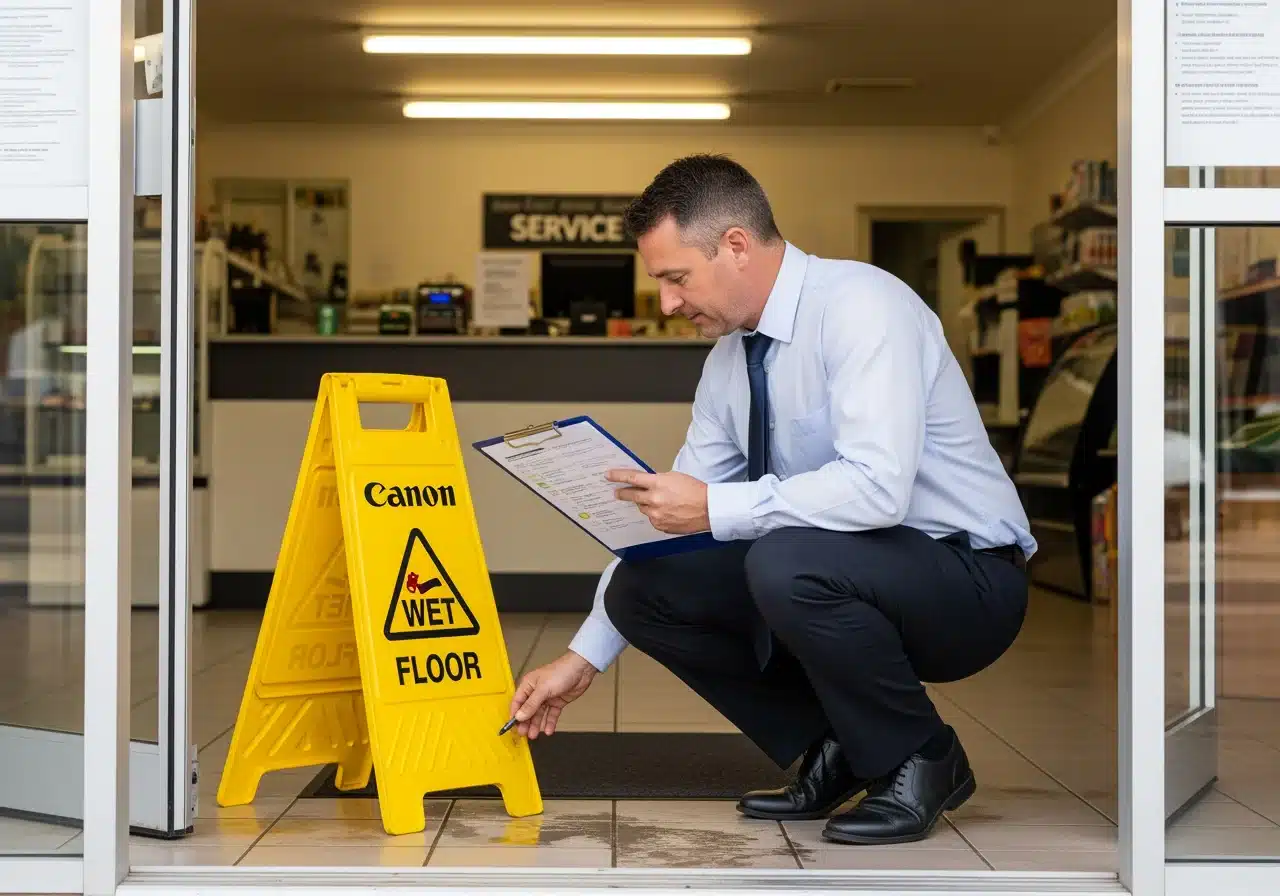
A customer slips on a wet floor at a retail store and fractures their hip. A contractor trips over unmarked cables at a construction site and suffers spinal injuries. A visitor to an office building is struck by falling debris from maintenance work overhead. These incidents share a common thread – they were preventable through proper business risk assessment.
Beyond financial impact, these incidents damage reputation, disrupt operations, and in severe cases, result in criminal prosecution under work health and safety legislation. Yet many NSW businesses still operate without comprehensive business risk assessment frameworks, treating safety compliance as a box-ticking exercise rather than a strategic business function.
The gap between legal obligation and actual practice creates exposure that extends far beyond insurance premiums. Understanding why systematic risk assessment matters – and how to implement it effectively – determines whether a business protects itself or becomes another cautionary tale in the courts.
The Legal Framework Surrounding Business Risk Assessment
WHS Act, Civil Liability Act, and Insurance Obligations
NSW businesses operate under overlapping legislative requirements that mandate proactive risk management. The Work Health and Safety Act 2011 (NSW) establishes a primary duty of care requiring persons conducting a business or undertaking (PCBUs) to ensure, so far as is reasonably practicable, the health and safety of workers and others affected by their operations. This isn’t limited to employees – it extends to customers, contractors, visitors, and the general public.
The Civil Liability Act 2002 (NSW) further shapes obligations by defining negligence standards in personal injury claims. Section 5B requires plaintiffs to prove the defendant breached a duty of care, but courts assess this breach against what a reasonable person in the defendant’s position would have done. business risk assessment frameworks provide documentary evidence of reasonable precautions, creating a defensible position when incidents occur.
The High Court confirmed in Shirt v Wyong Shire Council (2010) that risk assessment must consider probability, severity, burden of precautions, and social utility – factors now embedded in standard risk matrices. Insurance policies add another layer of obligation. Most public liability insurance policies include conditions requiring businesses to take reasonable precautions to prevent injury or property damage. Failing to conduct risk assessments can void coverage, leaving businesses personally liable for claim settlements and legal costs that would otherwise be covered.
Consequence Layers for Inadequate Risk Management
Failure to conduct adequate risk assessments exposes businesses to multiple consequences. SafeWork NSW can issue improvement notices, prohibition notices, or on-the-spot fines ranging from $1,500 to $6,000. Serious breaches trigger Category 1 offences under the WHS Act, carrying maximum penalties of $3 million for corporations. Criminal prosecution becomes possible when reckless conduct causes death or serious injury.
Common Public Liability Risks Across Business Sectors
Premises Hazards, Product Liability, and Service Risks
Public liability prevention NSW exposure varies by industry, but certain risk categories appear consistently across NSW businesses. Identifying these patterns helps target assessment efforts where they deliver maximum protection.
Slip, trip, and fall incidents dominate this category – wet floors without warning signage, uneven surfaces, inadequate lighting, cluttered walkways, and poorly maintained stairs. Retail environments face particular exposure during peak trading periods when floor maintenance coincides with high foot traffic. Commercial properties with outdoor areas must assess risks from weather exposure, landscaping hazards, and car park safety.
Product liability extends beyond manufacturers to retailers, distributors, and suppliers. Defective products, inadequate safety warnings, and failure to recall dangerous items create exposure under Australian Consumer Law. A business risk assessment framework must include product safety protocols, supplier verification processes, and incident response procedures for product-related injuries.
Service delivery risks arise from how businesses interact with customers and the public. Professional services face claims from negligent advice or errors in service delivery. Hospitality businesses confront risks from food safety, alcohol service, and crowd management. Event organisers must assess risks from temporary structures, crowd control, emergency egress, and contractor activities.
Contractor Activities, Cyber Risks, and Geographic Factors
Third-party contractor activities create vicarious liability exposure. When contractors work on business premises or deliver services on behalf of the business, their negligent acts can trigger claims against the principal business. This includes delivery drivers, maintenance contractors, security personnel, and professional service providers. Risk assessment must verify contractor insurance, competency, and safety procedures. Where a contractor is involved in a road incident while performing work duties, the principal business may also face exposure through a motor vehicle accident claim if it exercised control over the contractor’s activities.
Cyber and data-related risks increasingly trigger public liability exposure as businesses collect and store customer information. Data breaches affecting customer privacy can result in compensation claims, particularly when financial loss or identity theft occurs. The Privacy Act 1988 (Cth) creates obligations that, when breached, can form the basis for negligence claims.
Geographic factors compound these risks across Australia. Coastal businesses face storm damage and flooding risks. Rural operations confront wildlife hazards and limited emergency service access. Urban businesses deal with higher foot traffic volumes and complex multi-occupancy premises. business risk assessment must account for location-specific factors that standard templates often overlook.
Financial Impact Beyond Insurance Premiums
The true cost of inadequate business risk assessment extends far beyond the direct expenses of claim settlements and legal fees. NSW businesses that suffer public liability incidents face cascading financial consequences that threaten viability.
Direct Claim Costs and Operational Disruption
Direct claim costs represent just the visible portion of exposure.
Operational disruption costs often exceed claim settlements. When SafeWork NSW issues prohibition notices, business operations cease until compliance is demonstrated. A retail store closed for safety violations loses daily revenue averaging $5,000-$15,000 while still carrying fixed costs for rent, utilities, and wages. Manufacturing operations face supply chain disruption costs when production stops unexpectedly.
Reputation Damage, Regulatory Penalties, and Employee Morale
Reputation damage creates long-term revenue impact that financial statements struggle to capture. Media coverage of serious incidents drives customers to competitors, particularly in service industries where trust determines purchasing decisions.
Opportunity costs compound as management attention diverts from growth activities to incident response. Senior executives spending weeks managing investigations, legal proceedings, and remediation cannot simultaneously pursue new business opportunities. Strategic initiatives stall while the organisation operates in crisis mode.
Employee morale and retention suffer after serious incidents, particularly when they involve public injuries on business premises. Recruitment costs increase as prospective employees research the business’s safety record. High-performing staff members leave for competitors with better safety cultures, taking institutional knowledge and client relationships with them. Where worker injuries occur alongside public liability incidents, businesses may face simultaneous workers compensation claims and third-party liability proceedings.
Regulatory penalties add direct costs that insurance doesn’t cover. SafeWork NSW fines, court-ordered penalties, and enforceable undertakings requiring safety improvements can total hundreds of thousands of dollars. Directors face personal liability for Category 1 offences, creating exposure to their personal assets beyond business insurance limits.
The Risk Assessment Process That Actually Works
Effective business risk assessment in NSWrequires systematic methodology, not generic templates downloaded from government websites. NSW businesses need frameworks tailored to their specific operations, premises, and client interactions.
Hazard Identification and Risk Analysis
business risk assessment assessments in NSW begins with comprehensive workplace and premises inspections. This involves physically walking through all areas accessible to the public, observing operations during different times and conditions, and consulting with frontline staff who interact daily with customers and visitors. The process must capture obvious hazards like damaged flooring, but also subtle risks like glare from windows creating visibility issues or noise levels interfering with safety communications.
Engaging external perspectives improves identification accuracy. Fresh eyes spot hazards that familiarity has rendered invisible to regular occupants. Professional risk assessors bring experience from similar businesses, recognising patterns that predict incidents. Customer feedback and complaint records reveal hazards that businesses might otherwise dismiss as isolated concerns.
Risk analysis evaluates identified hazards using structured matrices that assess likelihood and consequence. The analysis must consider frequency of exposure – a minor hazard affecting thousands of customers weekly presents greater risk than a severe hazard encountered rarely.
Consequence assessment extends beyond immediate injury to include potential for long-term disability, psychological trauma, and third-party impacts. A slip hazard causing minor bruising carries different risk weighting than one near stairs where falls could cause head injuries or spinal damage.
Risk Evaluation, Control Implementation, and Documentation
Risk evaluation determines which risks require immediate action versus those acceptable under current controls. This involves comparing assessed risk levels against the business’s risk appetite and legal obligations. Some risks cannot be eliminated entirely – the question becomes whether remaining risk after implementing controls falls within acceptable bounds.
Legal compliance creates minimum thresholds that override business risk appetite. If a hazard violates specific safety standards or building codes, it requires remediation regardless of assessed likelihood. Professional liability risks often demand precautions beyond what pure risk calculation would suggest, because courts apply higher standards to professional services.
Risk control implementation follows the hierarchy of controls established in WHS legislation. Elimination removes the hazard entirely – redesigning a space to eliminate trip hazards rather than simply marking them. Substitution replaces high-risk processes with safer alternatives. Engineering controls use physical changes to reduce risk – installing slip-resistant flooring rather than relying on cleaning protocols.
Administrative controls including procedures, training, and signage form the next tier. These require ongoing management to remain effective, making them less reliable than engineering solutions. Personal protective equipment represents the last resort when other controls prove insufficient.
Documentation throughout the process creates the evidence base that defends against negligence claims. Risk registers must record identified hazards, assessment methodology, evaluation decisions, implemented controls, and review schedules. This documentation proves the business met its duty of care by taking reasonable precautions based on known risks.
Regular Review and Maintaining Current Frameworks
Regular review and update keeps business risk assessment frameworks current as operations evolve. Significant changes – new equipment, modified premises layouts, different service offerings, or changed customer demographics – trigger immediate reassessment. Even without changes, annual review ensures controls remain effective and new hazards receive attention.
When Risk Assessment Prevents Liability Claims
The difference between businesses that successfully defend liability claims and those that settle for significant amounts often comes down to documented business risk assessment and implemented controls. NSW courts consistently reference risk assessment quality when determining negligence.
Case Law Demonstrating the Value of Documentation
In Vairy v Wyong Shire Council [2005] HCA 62, the High Court examined what constitutes reasonable precautions against foreseeable risks. The council had conducted risk assessments of its swimming facilities but failed to implement all recommended controls due to budget constraints. The court found this insufficient, establishing that financial considerations cannot override obligations to address known serious risks. The principle applies equally to private businesses – identifying risks without acting on findings provides no legal protection.
Conversely, Shirt v Wyong Shire Council demonstrated how documented business risk assessment and implemented controls can defeat claims even when injuries occur. The council had assessed risks from its rock pools, implemented signage and supervision protocols appropriate to the assessed risk level, and regularly reviewed effectiveness. When a swimmer suffered injuries, the court found the council had met its duty of care despite the incident occurring. The risk assessment evidence proved the council had taken reasonable precautions proportionate to the identified risk.
This principle extends to commercial premises. Businesses have successfully defended slip and fall claims by producing detailed risk assessments covering floor maintenance, weather-related hazards, and peak traffic management. Security footage showing staff had followed documented cleaning protocols, including warning signage placement, has convinced courts that businesses had implemented reasonable precautions, with incidents resulting from plaintiff inattention rather than negligence.
Insurance Defence and Cultural Change Benefits
business risk assessment creates multiple legal advantages when claims arise. It demonstrates foreseeability – the business had considered the type of incident that occurred and taken steps to prevent it. It shows proportionality – the precautions matched the assessed level of risk. It evidences reasonableness – the business acted as a prudent operator in similar circumstances would act.
Insurance defence strengthens significantly with documented public liability prevention measures. Insurers investigating claims look for evidence that the insured met policy conditions requiring reasonable precautions. Comprehensive risk assessments satisfy this requirement, ensuring coverage responds when needed. Without such documentation, insurers may dispute coverage, leaving businesses personally liable for defence costs and settlements.
The assessment process itself often prevents incidents by changing organisational culture. Staff trained to identify and report hazards become active participants in safety management rather than passive recipients of top-down instructions. Regular Goodman Spring risk assessment reviews create forums for discussing near-misses and implementing improvements before incidents occur.
Implementing Risk Assessment Without Disrupting Operations
Many NSW businesses delay implementing systematic business risk assessment because they perceive it as resource-intensive and operationally disruptive. This misconception costs more than the assessment process ever would.
Starting With High-Risk Areas and Existing Reviews
Start with high-risk areas rather than attempting comprehensive assessment simultaneously across all operations. Public-facing areas where customers and visitors congregate demand priority attention. Reception areas, retail floors, customer service centres, and public amenities carry higher exposure than back-office spaces. Focus initial assessment efforts where incidents most commonly occur and where consequences prove most severe.
Integrate assessment into existing operational reviews rather than creating separate processes. Monthly management meetings can include standing agenda items for hazard identification and control effectiveness review. Maintenance schedules can incorporate risk assessment checks alongside routine inspections. Staff training sessions can include hazard spotting exercises that feed into formal risk registers.
Leverage technology to streamline documentation and tracking. Mobile apps allow frontline staff to photograph hazards and submit reports instantly from the field. Cloud-based risk management platforms enable real-time collaboration across multiple locations, with automated reminders for scheduled reviews. Digital systems create audit trails that demonstrate ongoing attention to risk management.
Technology, Staff Engagement, and Phased Implementation
Engage staff at all levels to distribute assessment workload and improve identification accuracy. Frontline employees encounter hazards daily that senior management never sees. Creating reporting mechanisms that encourage hazard identification without blame transforms staff into an early warning system. Recognition programs that reward proactive hazard reporting reinforce desired behaviours.
External expertise accelerates implementation without requiring permanent additional headcount. Specialists understand how business risk assessment documentation influences claim outcomes and can guide businesses toward legally defensible frameworks. Safety consultants bring industry-specific knowledge and assessment experience that internal teams may lack. The investment in external expertise during initial implementation pays dividends through reduced long-term exposure.
Template customisation provides starting points without requiring creation from scratch. Industry associations often provide sector-specific risk assessment templates that members can adapt to their operations. Government agencies including SafeWork NSW offer free resources that meet baseline legal requirements. The key is customisation – generic templates applied without modification fail to address business-specific risks and provide little legal protection.
Phased implementation allows businesses to build capability progressively. Begin with simple risk assessments covering obvious hazards and basic controls. As staff develop assessment skills and systems mature, expand to more complex risk scenarios and sophisticated control measures. This approach prevents overwhelm while demonstrating continuous improvement to regulators and insurers.
Conclusion
Public liability prevention of incidents in NSW don’t announce themselves in advance, but the conditions that enable them develop over months and years of inadequate risk management. NSW businesses operating without systematic business risk assessment frameworks gamble with financial viability, reputation, and in extreme cases, their continued existence. The question isn’t whether risk assessment delivers value – the evidence from courts, insurers, and business outcomes conclusively answers that. The question is whether business owners will implement effective frameworks before incidents occur or after.
The legal obligations are clear, the financial stakes are substantial, and the operational disruption from serious incidents far exceeds the investment required for proper business risk assessment. Businesses that treat safety as a compliance burden rather than a strategic business function consistently underperform those that embed risk management into daily operations. The choice between proactive assessment and reactive crisis management determines whether a business controls its future or becomes subject to forces it failed to anticipate.
For NSW businesses ready to implement business risk assessment frameworks that actually protect against liability exposure, professional guidance ensures efforts meet legal standards while fitting operational realities. Understanding how documented risk assessment strengthens legal positions and reduces exposure to preventable claims represents sound business strategy. The cost of prevention remains a fraction of the cost of defending negligence claims that proper assessment would have prevented.
If your business needs guidance on implementing comprehensive public liability prevention NSW measures or has experienced an incident where risk assessment adequacy is questioned, speak with our public liability lawyers on or call (02) 9261 1799 to discuss how systematic risk assessment can protect both your customers and your business from preventable harm.