When a child suffers an injury at school, parents face immediate concerns about medical treatment, recovery time, and whether the incident could have been prevented. Beyond the emotional toll, these situations often raise complex questions about legal responsibility and compensation rights. Schools across Australia operate under specific duty of care obligations, and understanding how these apply to playground accidents, sporting injuries, and classroom incidents helps parents determine when legal action may be warranted.
Education departments across Australia reported thousands of serious injury incidents in public schools annually, with playground falls accounting for a significant portion of these cases. While not every school injury indicates negligence, certain circumstances – inadequate supervision, poorly maintained equipment, or failure to follow safety protocols – may give rise to valid school injury compensation claims. Parents need accurate information about their legal options, the evidence required to support a claim, and the timeframes that apply to taking action.
Understanding School Duty of Care in Australia
Schools owe students a non-delegable duty of care, meaning they cannot transfer this responsibility to contractors, volunteers, or other parties. This duty requires schools to take reasonable steps to protect students from foreseeable risks of injury. The standard applied is that of a reasonable and prudent parent, adjusted for the school environment where staff supervise multiple children simultaneously.
Scope of the Duty of Care
The duty of care extends beyond classroom hours to include playground supervision during breaks and lunch periods, sporting activities including PE classes and competitive sports, excursions and camps off school premises, before and after school care provided by the school, and school transport for sanctioned activities.
Courts assess whether schools met their duty by examining what a reasonable school would have done in similar circumstances. This includes evaluating staff-to-student ratios, the adequacy of supervision for the activity type, and whether the school had systems to identify and address known hazards.
Systems for Supervision and Safety
Legal precedent has established that schools must implement proper systems for student supervision and safety. A single lapse in supervision does not automatically constitute negligence, but systematic failures – such as regularly leaving playgrounds unsupervised or ignoring repeated complaints about dangerous equipment – may breach the duty of care.
Common School Injury Scenarios and Liability
Playground Equipment Injuries
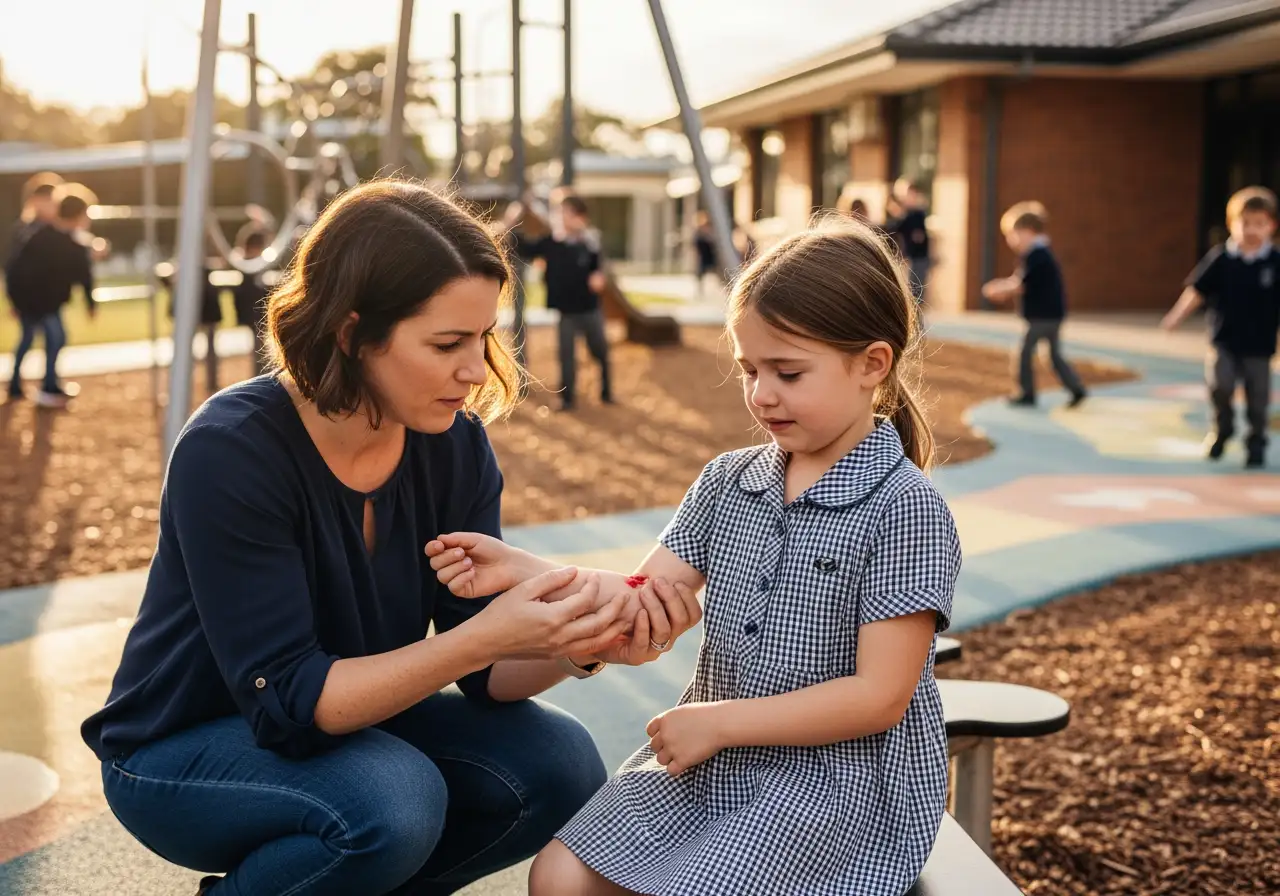
Playground injuries represent the largest category of school accidents across Australia. Equipment-related injuries often involve falls from climbing structures, swings, or monkey bars onto inadequate surfacing materials. Australian Standard AS 4685 specifies impact-absorbing surfaces under playground equipment, with depth and material requirements based on fall heights. Schools that fail to maintain compliant surfacing or allow it to deteriorate may face public liability claims when children suffer head injuries or fractures from falls.
Entrapment injuries occur when children’s clothing, body parts, or equipment becomes caught in gaps, chains, or moving parts. The standard requires regular inspections to identify entrapment hazards, and schools must remove or repair non-compliant equipment promptly.
Equipment failure injuries result from broken swings, rusted chains, splintered timber, or structural defects. Schools must conduct routine maintenance inspections and address identified defects before allowing continued use. Documentation of inspection schedules and maintenance records becomes crucial evidence in injury claims.
Sporting and Physical Education Injuries
Sport involves inherent risks, but schools must still take reasonable precautions. Liability may arise when inadequate instruction or supervision leads to injury. Teachers must provide proper technique instruction, ensure appropriate skill matching in contact sports, and maintain active supervision during activities. A Year 7 student suffering a serious head injury in rugby when matched against significantly larger Year 9 students may indicate inadequate risk management.
Equipment or facility defects cause harm when schools fail to inspect facilities before use. This includes slippery gym floors, protruding nails in cricket pitches, or damaged goal posts. Schools must withdraw unsafe equipment from service.
Failure to follow return-to-play protocols after concussion or injury creates additional liability risks. Education guidelines require specific protocols before students return to sport after head injuries. Schools that allow premature return to contact sports risk liability for subsequent injuries.
The inherent risk principle applies to sporting injuries – participants accept certain risks inherent to the sport. However, this does not excuse schools from their duty to minimise foreseeable risks through proper supervision, equipment maintenance, and safety protocols. Personal injury compensation remains available when schools breach their duty of care, even in sporting contexts.
Bullying and Assault-Related Injuries
Schools must take reasonable steps to prevent foreseeable harm from other students. When a child suffers physical injuries from bullying or assault, liability depends on whether the school knew or should have known about the risk of violence, took adequate steps to protect the injured student, implemented and enforced anti-bullying policies, and responded appropriately to previous incidents or complaints.
A single unpredictable assault between students with no prior conflict rarely establishes negligence. However, when parents have repeatedly reported bullying, the school has documented previous incidents, or teachers witnessed escalating aggression without intervention, the school may have breached its duty of care.
Legal precedent has confirmed schools can be liable for student-on-student violence when they fail to respond adequately to known risks. Cases have involved students with documented behavioural issues who assaulted other students after schools failed to implement promised supervision measures.
Building a School Injury Compensation Claim
Successful school injury compensation claims require establishing four elements: the school owed a duty of care, it breached that duty through negligence, the breach caused the injury, and the child suffered quantifiable damages.
Evidence Collection Strategies
Immediate documentation following the injury proves critical. Parents should request a copy of the school’s incident report within 24 hours. These reports often contain staff admissions about supervision gaps, equipment defects, or protocol failures that may later be downplayed.
Photograph the injury site, including equipment condition, surface materials, signage, and environmental factors. Take multiple angles and include reference points for scale. If the injury occurred on playground equipment, photograph warning labels, maintenance tags, and the surrounding area.
Obtain witness statements from other students, parents, or staff who observed the incident or its immediate aftermath. Memories fade quickly, and witnesses may become unavailable or less willing to provide statements months later.
Medical evidence establishes both causation and damages. Ensure treating doctors document the injury mechanism, treatment required, prognosis, and any ongoing limitations or therapy needs. For serious injuries, obtain specialist reports addressing long-term impacts on education, development, or future earning capacity.
School Records and Documentation Requests
School records reveal patterns and context. Request previous incident reports involving the same equipment or location, maintenance and inspection logs for relevant equipment or facilities, risk assessments for the activity during which injury occurred, supervision rosters and staff-to-student ratios at the time of injury, and relevant policies and whether staff received training on their implementation.
Schools must provide these documents under Government Information (Public Access) Act 2009 requests, though they may claim exemptions for certain material.
Proving Negligence in School Settings
Negligence requires showing the school failed to take reasonable precautions against foreseeable risks. This involves demonstrating foreseeability – a reasonable school should have anticipated the risk. Playground falls from height are clearly foreseeable, requiring compliant impact-absorbing surfaces. Injuries from equipment defects are foreseeable when inspection systems fail to identify and address deterioration.
Breach of standard demonstration shows the school’s actions fell below what a reasonable school would do. This may involve comparing the school’s practices to Australian Standards for playground equipment, sporting facilities, or supervision, education guidelines and policies, industry best practices and expert evidence about reasonable precautions, and the school’s own policies and whether staff followed them.
Expert evidence often proves essential. Playground safety experts can assess whether equipment and surfacing met standards. Education experts can evaluate whether supervision arrangements and safety protocols aligned with reasonable practices. Medical experts establish causation – that the school’s negligence, rather than the inherent activity risk, caused the specific injury.
Causation links the breach to the injury. Proof on the balance of probabilities is required that proper supervision, maintained equipment, or followed protocols would have prevented the injury. This can be straightforward in equipment failure cases but more complex in supervision claims.
Compensation Categories for Injured Students
School injury compensation claims can include multiple damage categories, depending on injury severity and long-term impacts.
Medical and Treatment Costs
Medical and treatment costs cover past and future expenses including hospital treatment, surgery, rehabilitation, physiotherapy, psychology services, and medications. Serious injuries may require ongoing treatment for years, with expert evidence projecting lifetime care costs.
Pain and Suffering
Pain and suffering compensates for physical pain, emotional trauma, and loss of enjoyment of life. Australia uses a statutory scale for non-economic loss, with maximum amounts for the most severe injuries. A permanent significant impairment threshold applies – injuries must meet minimum severity levels to claim pain and suffering damages.
Loss of Education and Future Economic Loss
Loss of education and development addresses how injuries impact learning, particularly when students miss extended school time or suffer cognitive injuries affecting academic performance. This may include costs for tutoring, educational support, or modified schooling arrangements.
Future economic loss applies to severe injuries affecting earning capacity. For young students, this requires complex calculations about likely career paths, how injuries limit employment options, and present value of lifetime earnings reductions. Vocational experts assess functional limitations and employment impacts. Where injuries result in lasting disability, TPD claims through superannuation may provide additional financial support when the child reaches working age.
Care and Assistance
Care and assistance compensates families for care provided to injured children beyond normal parenting duties. Severe injuries may require ongoing assistance with daily activities, transport to medical appointments, or supervision due to cognitive impairments. Both past care (typically valued at commercial rates) and future care needs may be claimed.
Time Limits for School Injury Claims
The Limitation Act imposes strict timeframes for commencing legal action across Australia. For children under 18, the limitation period does not begin running until they turn 18, giving them until their 21st birthday to commence proceedings for most personal injury claims.
Practical Considerations for Earlier Action
However, practical considerations often make earlier action advisable. Evidence preservation becomes more difficult with time. Witnesses relocate or forget details, schools destroy records after retention periods expire, and injury sites change through renovations or equipment replacement. Photographs taken years after an incident carry less weight than contemporaneous documentation.
Financial pressures may require earlier resolution. Families facing significant medical costs, loss of income from caring for injured children, or the need for home modifications may require compensation sooner than waiting until the child turns 18.
Psychological closure benefits both children and families. Protracted uncertainty about legal matters can impede emotional recovery, while resolution allows families to move forward with appropriate support arrangements.
Parental Claim Limitations
Parents can commence proceedings as litigation guardian on behalf of minor children. Courts must approve any settlement involving minors, ensuring proposed compensation adequately addresses the child’s needs and that legal costs are reasonable.
The three-year limitation period for adults applies to parents claiming their own losses, such as loss of income from caring for an injured child. These claims run from the injury date, not the child’s 18th birthday.
Goodman Spring assists parents navigating school injury compensation claims across NSW and Australia, providing specialist guidance on legal rights, evidence requirements, and the compensation process for injured students – all on a no win no fee basis.
When Schools Deny Responsibility
Schools and their insurers frequently dispute liability for student injuries, employing several common defences.
Inherent Risk and Contributory Negligence
Inherent risk arguments claim the injury resulted from risks inherent to the activity that cannot be eliminated without fundamentally changing its nature. Courts recognise that active play involves some injury risk, and schools need not eliminate all possibility of harm. However, inherent risk does not excuse failures to take reasonable precautions or maintain safe equipment.
Contributory negligence alleges the injured student’s own actions contributed to the injury. Australia applies proportionate liability – if a student is found 30% responsible for their injury, damages reduce by 30%. This defence often arises in sporting injuries where students ignored instructions or acted recklessly. However, courts adjust expectations for children’s behaviour based on age and maturity.
Voluntary Assumption of Risk and Causation Disputes
Voluntary assumption of risk claims the student willingly participated in an activity knowing its dangers. This defence rarely succeeds for school injuries, as children cannot be said to voluntarily assume risks created by the school’s negligence, such as defective equipment or inadequate supervision.
Causation disputes argue something other than the school’s actions caused the injury. Schools may claim injuries resulted from pre-existing conditions, occurred outside school hours or premises, or stemmed from factors beyond their control.
Responding to denied claims requires methodical evidence presentation. Detailed witness statements, expert reports addressing the school’s specific defences, and documentary evidence of the school’s knowledge of risks or previous similar incidents strengthen the response to denial.
The Claims Process for School Injuries
School injury compensation claims typically follow this progression.
Initial Investigation and Letter of Claim
Initial investigation (1-3 months) involves gathering evidence, obtaining medical reports, and assessing claim viability. Lawyers review incident reports, interview witnesses, and may engage preliminary expert opinions on liability issues.
Letter of claim formally notifies the school and its insurer of the claim, outlining the incident, injuries, alleged negligence, and damages sought. The letter triggers the insurer’s investigation and provides opportunity for early resolution.
Insurer Investigation and Pre-Litigation Negotiation
Insurer investigation (2-4 months) sees the insurer reviewing school records, interviewing staff, and obtaining their own expert opinions. They may make an early settlement offer, deny liability, or request additional information.
Pre-litigation negotiation attempts to resolve claims without court proceedings. Many school injury claims settle at this stage when liability is clear and parties agree on damages quantum. Settlement negotiations may involve mediation – a structured process where an independent mediator facilitates discussions.
Court Proceedings and Resolution
Court proceedings commence if settlement negotiations fail. This involves filing a Statement of Claim, the defendant filing a Defence, exchange of evidence through the discovery process, expert conferences to narrow disputed issues, and potentially a hearing where a judge determines liability and damages.
Settlement or judgment concludes the process. Most claims settle before hearing, often shortly before the scheduled trial date. Settlements involving minors require court approval to ensure adequacy and protect the child’s interests.
The entire process typically takes 12-24 months for straightforward cases, longer for complex injuries requiring extended treatment to assess final outcomes. Workers compensation lawyers Sydney families engage may also be relevant when school staff suffer injuries, though this operates under different frameworks than student injury claims. For Commonwealth-employed school staff, comcare workers compensation Sydney entitlements apply instead of state workers compensation schemes.
Choosing Legal Representation for School Injury Claims
School injury compensation claims involve technical legal issues, complex evidence requirements, and defendants with experienced legal teams. Selecting appropriate legal representation significantly impacts claim outcomes.
Specialisation and No Win No Fee Arrangements
Specialisation matters – personal injury lawyers with specific experience in school injury claims understand the applicable legal principles, common defences, and effective evidence strategies. They maintain relationships with relevant expert witnesses and understand how courts assess these claims.
No win, no fee arrangements make legal representation accessible regardless of financial circumstances. Under these conditional costs agreements, lawyers receive payment only if the claim succeeds, typically as a percentage of recovered damages (capped by law) or on a time-based billing discounted if the claim fails.
Communication, Support, and Initial Consultations
Communication and support prove particularly important for parents navigating unfamiliar legal processes while managing their child’s recovery. Lawyers should explain processes clearly, provide realistic assessments of claim prospects, and remain accessible for questions throughout the claim.
Initial consultations typically occur at no cost, allowing parents to discuss the incident, understand their legal options, and assess whether the lawyer is appropriate for their needs before committing to representation.
Conclusion
School injuries can have lasting impacts on children’s physical health, educational progress, and emotional wellbeing. While schools cannot prevent every injury, they must maintain reasonable safety standards, provide adequate supervision, and respond appropriately to known risks. When schools breach these duties through negligence, injured students and their families have legal rights to pursue compensation.
Understanding the elements of a valid claim, the evidence required to prove negligence, and the compensation available helps parents make informed decisions about their legal options. Time-sensitive evidence collection, realistic assessment of liability prospects, and strategic claim presentation all contribute to successful outcomes.
Parents facing school injury situations should seek specialist legal advice promptly to protect their child’s rights, preserve crucial evidence, and ensure claims are properly prepared and pursued. While no compensation can undo serious injuries, appropriate settlements provide resources for ongoing treatment, support services, and addressing long-term impacts on children’s development and future opportunities.
For expert guidance on playground accident claims and other school-related injuries, contact our personal injury lawyers or call (02) 9261 1799 to discuss specific situations and the legal options available for families dealing with student injuries.